

Disclaimer: This article is for informational purposes only. It does not constitute legal or medical advice. The legal status of THCA and 7-Hydroxymitragynine (7-OH) varies by jurisdiction and is subject to rapid change. Consume responsibly and at your own risk.
We are living in the Golden Age of the Gray Market.
If you walk into a smoke shop in Texas, Tennessee, or Florida right now, you will see shelves stacked with products that would have been felonies ten years ago. But thanks to some very clever chemistry and some very poorly written laws, you can now buy “weed” and “opioids” with a credit card, a smile, and a valid ID.
But not all loopholes are created equal.
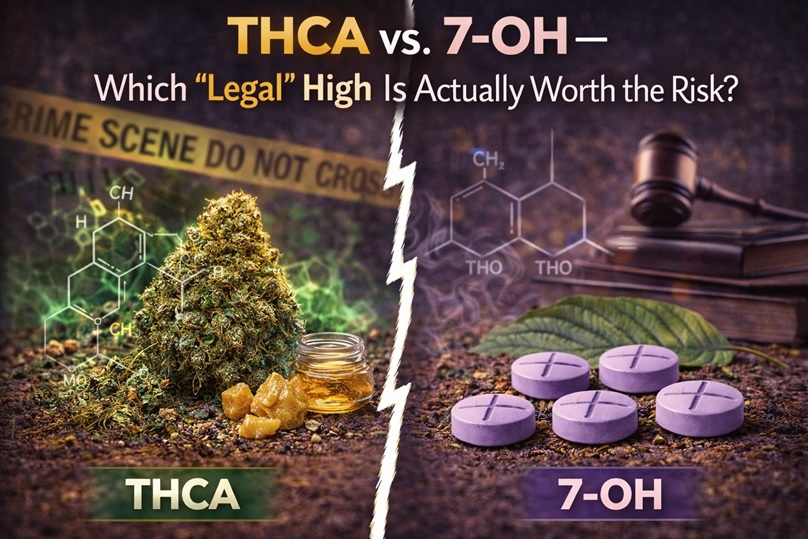
In the red corner, we have THCA Flower: the “hemp” that is chemically identical to marijuana the moment you light it on fire. In the blue corner, we have 7-Hydroxymitragynine (7-OH): the potent kratom alkaloid that hits your opioid receptors like a freight train but is sold as a “botanical supplement.”
Both are legal (for now). Both get you high. But which one is actually the better tool for the modern psychonaut?
Let’s break down the Loophole Wars on the three metrics that actually matter: Cost, Safety, and Discretion.
Round 1: The Cost Per High
If you are trying to ball on a budget, the winner is clear. But if you want a premium experience, the math gets tricky.
THCA: The Budget King
THCA flower is dirt cheap because it’s just… weed. It grows in the ground. You can buy a gram of high-quality, 30% THCA flower for about $10-$15 at a shop, or as low as $5/gram in bulk online.
- The Math: A 1-gram joint of 30% THCA contains roughly 300mg of potential THC. Even if you have a high tolerance, that single $10 joint can provide 3-4 solid sessions.
- Cost Per Session: $2.50 – $3.00. It’s cheaper than a latte.
7-OH: The Premium Ticket
7-OH is not a plant; it’s an extraction. It requires complex lab work to isolate 7-hydroxymitragynine from the kratom leaf, where it naturally exists in tiny trace amounts. A standard 3-pack of 14mg tablets costs around $30-$35. That’s $10 per tablet.
- The Math: For a new user, half a tablet (7mg) is a strong dose. For an experienced user, you might need a full tablet (14mg) or more.
- Cost Per Session: $5.00 – $10.00.
- The Verdict: 7-OH is the “top shelf” option. You are paying for the processing, the potency, and the scarcity.
Winner: THCA (by a landslide).
Round 2: Legal Safety (The “Ban Hammer” Risk)
Which one of these loopholes is going to close first? This is where things get interesting.
THCA: Living on Borrowed Time
THCA exists because of the 2018 Farm Bill, which defines “hemp” as cannabis with less than 0.3% Delta-9 THC. THCA is not Delta-9 THC… until you heat it. Lawmakers are not stupid; they are just slow. States are already closing this loophole.
- The Risk: States like Florida, Georgia, and Tennessee are actively moving to ban “total THC” (THCA + Delta-9). The next Farm Bill could wipe this entire industry out overnight.
- The Smell Factor: If a cop pulls you over and smells your “legal hemp,” you are going for a ride. No field test can tell the difference between THCA flower and illegal marijuana. You might beat the charge in court, but you won’t beat the ride.
7-OH: The “Supplement” Shield
7-OH is in a much weirder gray area. It is an alkaloid of Kratom, which is federally legal. While the FDA is waging a war on it (seizing products, sending warning letters), there is no federal ban. The DEA has not scheduled it yet.
- The Risk: Some states (like Alabama, Arkansas, Indiana, Rhode Island, Vermont, and Wisconsin) have banned kratom entirely. But in most of the country, 7-OH is just a “dietary ingredient.”
- The “Look” Factor: 7-OH comes in professional blister packs. It looks like Claritin. If a cop finds it in your car, it’s just a pack of supplements. It doesn’t smell. It doesn’t look suspicious.
Winner: 7-OH. It’s harder to detect, harder to ban (without banning all kratom), and doesn’t carry the “probable cause” stench of weed.
Round 3: Discretion (The “Workday” Test)
Can you use it at work? Can you use it at a family dinner?
THCA: Zero Discretion
You have to smoke it or vape it. It smells loud. Your eyes get red. You get the “stupids.” THCA is a recreational drug. It is for the couch, the concert, or the hike. It is not for the boardroom.
- Drug Tests: THCA will pop hot on a drug test for 30+ days. It is exactly the same as weed.
7-OH: The Stealth Bomber
You swallow a tiny 7OH tablet. No smoke. No smell. No red eyes. The effects are internal: a warm body buzz, a mood lift, and laser focus. You don’t look high; you just look happy.
- Drug Tests: Standard 5-panel and 10-panel drug tests do not look for kratom or 7-OH. You would need a specialized test to get caught. It clears your system in 2-5 days.
Winner: 7-OH. It is the ultimate functional high.
The Final Verdict
So, which loophole is worth the risk?
Choose THCA if:
- You want to get stoned for cheap.
- You don’t have to worry about drug tests.
- You are using it at home or in safe, private spaces.
- You want the classic cannabis experience without the dealer.
Choose 7-OH if:
- You have a job, a family, and a reputation to maintain.
- You need a functional tool for pain, anxiety, or focus, not just a “trip.”
- You need to pass a standard drug test.
- You are willing to pay a premium for discretion and potency.
The Loophole Wars are raging, and the government is coming for both of them. But for now, the shelves are stocked.
Choose your fighter.
Ready to upgrade your arsenal? Find premium, lab-tested 7-OH tablets at 7oh.com.

Comments are closed.